
Why I’ve Been Producing Music Since 1998
Music has been part of my life for almost three decades.
The technology has changed, my artist name has changed, and my sound has evolved through several different stages. But the fascination behind it has remained the same.
I started producing electronic music in 1998. Back then, there were no streaming platforms, social media campaigns, AI tools, or easy digital distribution services. My first productions were created inside tracker software that probably looked more like a computer code interface than a music studio.
Today, I produce in Logic Pro, develop ALIMA as a complete artist brand, and prepare music for a global digital audience.
This is the story of how that journey began.
From Transylvania to My First Computer
I was born in Transylvania, Romania, at a time when access to Western technology was limited.
When my family moved to Germany, computers immediately fascinated me. To me, they represented an entirely new world. They were not just machines. They were gateways to creativity, information, and possibilities that I had never experienced before.
When I received money for my confirmation, I spent all of it on my first computer.
It had a 100 MHz processor, a double-speed CD-ROM drive, and I even bought a modern dot-matrix printer to complete the setup. Looking back, that purchase was one of the most important decisions of my life.
It was the beginning of everything.
At the same time, I was becoming increasingly fascinated by electronic music. Eurodance, Eurorave, techno, and the energetic sounds of the 1990s immediately caught my attention.
The synthesizers, rhythms, melodies, and atmosphere felt completely different from anything else.
I did not only want to listen to this music. I wanted to understand how it was created.
That curiosity eventually led me to tracker software.
Making Music Inside “The Matrix”
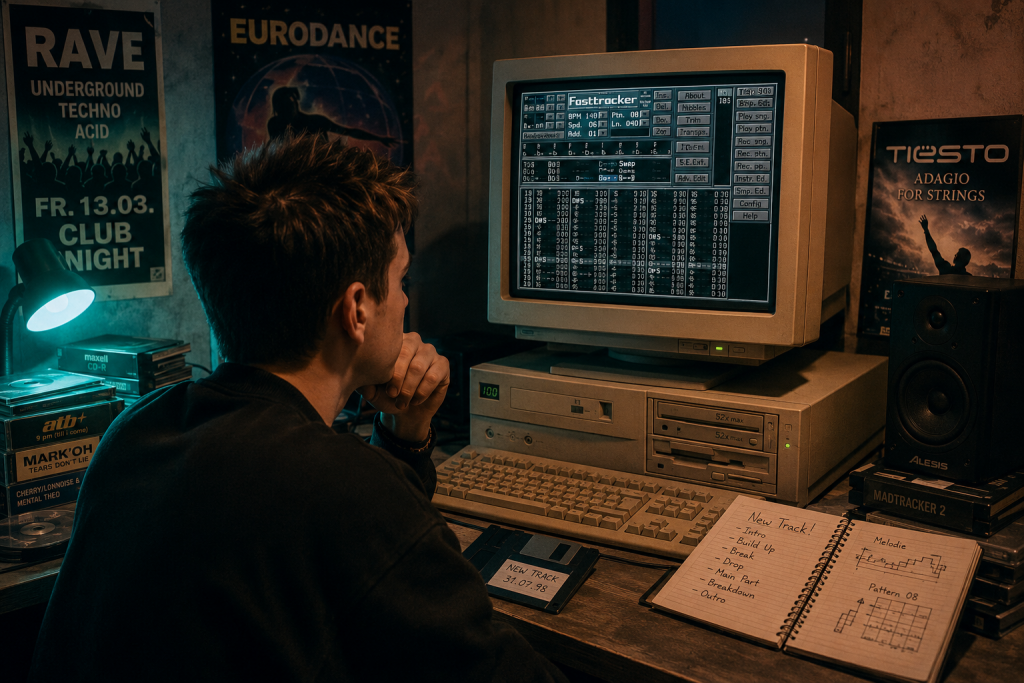
I started producing with FastTracker 2.
To someone who had never used a tracker, the interface probably looked more like something from The Matrix than a music production program. There were rows of numbers, commands, samples, patterns, and constantly moving information.
Almost nothing about it looked like a traditional musical instrument.
But to me, it was magic.
The first time I realized that I had created an actual piece of music inside that strange-looking program was an incredible feeling.
I knew that I had placed the sounds, written the patterns, built the structure, and created the melodies. This was not simply music playing from a computer.
It was my music.
That feeling became even stronger when I later heard my own tracks being played in clubs.
Watching people dance and celebrate to music I had created was difficult to describe. A track that had started privately in front of a computer screen could suddenly fill an entire room and create a shared experience between people.
That was when I understood how powerful electronic music could be.
Lost Patrol and My First Artist Identity
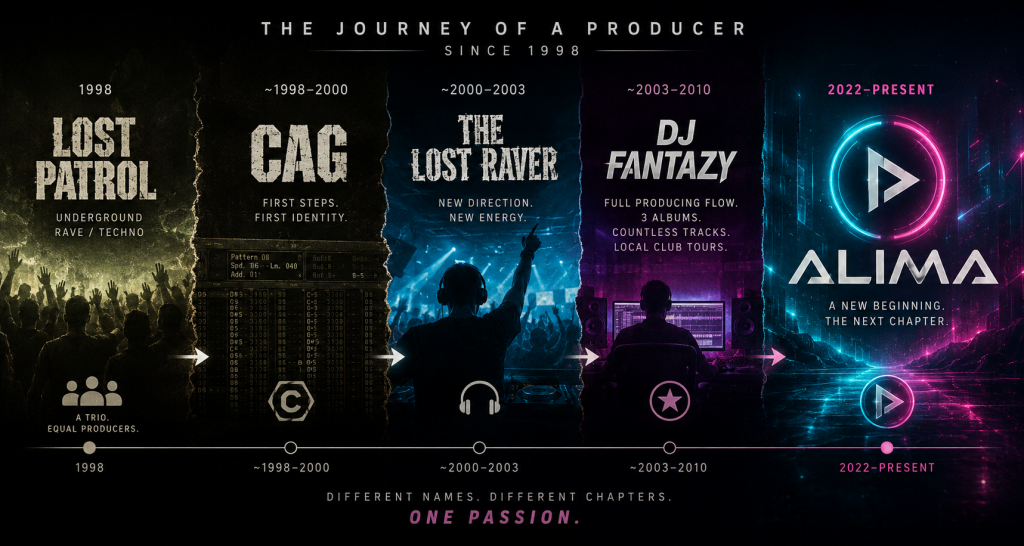
My first serious music project began around 1998 with a trio called Lost Patrol.
All three of us were equally involved in producing the music. Our sound was mainly based around underground rave and techno.
At the time, I used the artist name Cag.
Working as part of Lost Patrol gave me the opportunity to experiment, learn, and understand how electronic tracks were constructed. However, after a while, I realized that the musical direction did not completely satisfy me.
I loved the energy of underground rave and techno, but I wanted to create music that was more melodic, more accessible, and potentially more commercial.
That difference in direction eventually led to the end of the group.
After the separation, I changed my name to The Lost Raver. I used that identity for approximately two or three years.
It represented a transitional phase. The group was gone, but my determination to continue producing music remained.
Eventually, another name emerged.
DJ Fantazy.
The DJ Fantazy Years
By the time DJ Fantazy was established, I was fully immersed in music production.
Producing was no longer something I experimented with occasionally. It had become an essential part of my life.
Ideas came constantly, and I spent countless hours developing tracks, arrangements, melodies, and sounds.
During the DJ Fantazy period, I created three complete albums and numerous individual tracks. I released all of them independently.
This was long before today’s digital distribution systems made it possible to deliver a track to global streaming platforms with a few clicks.
There were no ready-made promotional campaigns, social media strategies, or pre-save pages supporting me.
I had to create the music, release it, and generate attention myself.
I also went from local club to local club to promote my name and my productions. Hearing my tracks in those environments and seeing how people reacted to them was one of the most rewarding parts of that time.
It confirmed that the music could work outside my own studio.
Staying Loyal to Trackers
My technical development continued alongside my artist journey.
I started with FastTracker 2 during the Lost Patrol period. Later, I switched to MadTracker and shortly afterwards to MadTracker 2.
During that time, many producers were beginning to move towards early digital audio workstations such as Cubase or FruityLoops.
I chose a different path.
I remained loyal to tracker-based production until 2010.
Trackers shaped the way I understand electronic music. They taught me to think precisely about timing, patterns, samples, arrangement, and structure.
Every sound had to be placed intentionally. Every command had a purpose.
Even though my production environment is completely different today, that technical foundation still influences how I work.
Discovering Trance
Even during my early underground rave and techno phase, I was increasingly drawn towards artists who combined powerful electronic energy with more accessible and memorable melodies.
Artists such as ATB, Mark ’Oh, and Charly Lownoise & Mental Theo showed me that electronic music could be energetic, emotional, and commercially successful at the same time.
I loved the harder rave elements, but I also wanted strong melodies and recognizable emotional moments in my own productions.
Then I heard one of the first trance tracks that truly changed my perspective.
I believe it was Tiësto’s Adagio for Strings.
I was completely fascinated.
The atmosphere, emotional progression, melody, and power of the track felt different from everything I had heard before. It was intense without depending only on hardness.
It created energy, but it also created emotion.
From that moment, I knew that I wanted to produce trance.
That decision continues to shape my music today.
The Break I Regret
Around 2010, I stopped producing music because of personal circumstances.
Today, I consider that decision one of the biggest mistakes of my musical journey.
At that point, I had already produced three albums, created numerous tracks, built experience in local clubs, and developed a clear understanding of electronic music.
I believe that a breakthrough was within reach.
But instead of continuing to build on what I had created, I stepped away.
For many years, that part of my story remained unfinished.
The passion never completely disappeared, but the active journey had stopped.
Returning to Music
In 2022, something changed.
My new relationship gave me fresh motivation, and I became determined not to let my talent and passion for electronic music disappear.
I had already spent too many years away from it.
I knew that returning would require more than opening an old project or creating one new track. The entire music industry had changed.
Production software had evolved. Streaming had replaced many traditional release formats. Social media had become a central part of music promotion. Visual identity and personal branding had become almost as important as the music itself.
I decided to approach the return with an all-or-nothing mentality.
For me, it was now or never.
Learning Logic Pro From the Beginning
Before relaunching my career, I needed to choose a modern digital audio workstation.
After extensive research, I selected Logic Pro. I was already planning to move towards Apple hardware, and Logic appeared to offer the professional environment I needed for the next stage of my journey.
The transition was significant.
Logic Pro worked completely differently from the trackers I had used for so many years.
The visual arrangement, instruments, effects, mixer, automation, audio editing, and overall workflow had to be learned from the beginning.
However, my technical understanding and years of musical experience made the transition manageable.
The software was new, but the fundamental principles of electronic music were not.
I already understood rhythm, melody, energy, arrangement, tension, and emotional progression. I simply had to learn how to express those ideas inside a completely different environment.
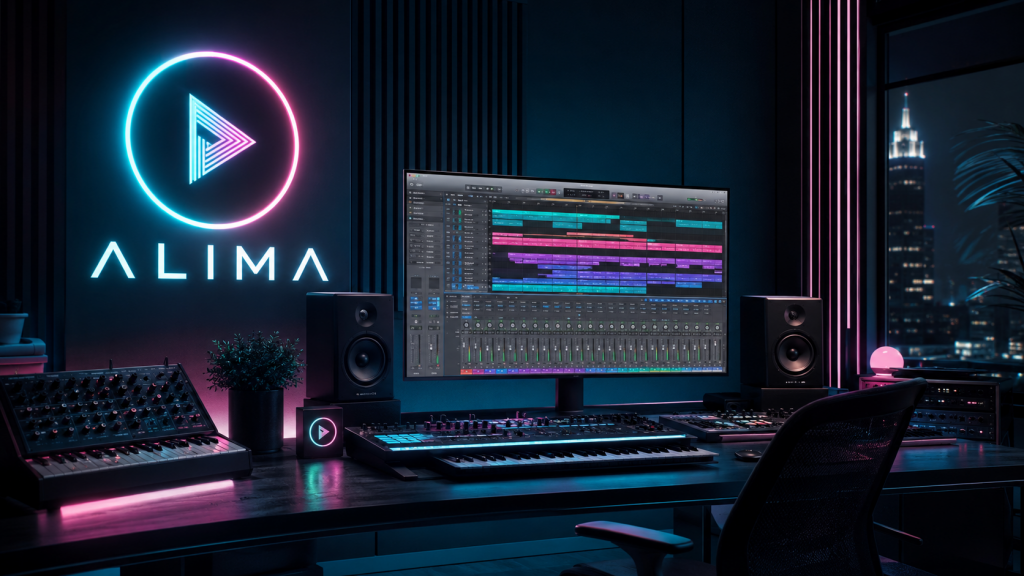
Logic Pro has remained the center of my production workflow ever since.
More recently, Suno AI has also become an important part of my creative process. I use it as an additional tool for exploring ideas, vocal concepts, lyrics, moods, and creative directions.
The results are then developed, shaped, arranged, and finalized within my own production workflow.
Technology has changed dramatically since 1998, but my motivation remains the same.
I still want to turn an idea into music that creates energy and emotion for other people.
Leaving DJ Fantazy Behind
My return also required me to look critically at my old artist identity.
DJ Fantazy had represented me for many years, but the name no longer felt appropriate.
To me, it sounded too playful and no longer reflected the mature and professional direction I wanted to take.
I began researching possible artist names online.
Eventually, I discovered the name ALIMA.
It immediately caught my attention.
The name was short, memorable, international, and visually strong. Most importantly, it felt like a genuine new beginning.
ALIMA did not erase my past.
It became the next stage of a journey that had already passed through Lost Patrol, Cag, The Lost Raver, and DJ Fantazy.
Each identity belonged to a different chapter.
ALIMA became the name under which I was ready to continue the story.
The decision was more than a simple rebrand. It represented a serious commitment to myself and to the music I still wanted to create.
I even had the ALIMA logo tattooed.
For me, there could be no clearer symbol that I was not planning to abandon this journey again.
Finding the Modern ALIMA Sound
After returning as ALIMA, my musical direction was initially strongly influenced by classic trance.
I wanted to reconnect with the sound that had originally inspired me while bringing it into a modern production environment.
Over time, my music developed towards progressive and mainfloor-oriented trance. The arrangements became more direct, the drops became stronger, and the overall sound moved closer to contemporary club and festival energy.
I also spent a period exploring uplifting trance.
That style taught me a great deal about emotional melodies, long builds, euphoric breakdowns, and the importance of creating a complete journey within a track.
Those influences are still part of my music today.
However, I gradually realized that mainfloor trance feels most natural to me.
It allows me to combine emotion, melody, power, and direct dancefloor impact. It can include classic trance elements without sounding trapped in the past.
It can be energetic without losing its musical character.
That is also how I would describe the direction of my upcoming releases.
They are built for the mainfloor, but they still carry the emotional and melodic identity that has always been central to my work.
At the same time, I do not want ALIMA to become musically predictable.
An upcoming collaboration with Simon, for example, moves strongly towards hardstyle. It combines my melodic approach with a harder and more aggressive energy.
For me, this does not represent a break from my identity.
Electronic music has always developed through experimentation.
From underground rave and techno to classic trance, progressive sounds, uplifting trance, mainfloor productions, and harder influences, every phase has added something to the way I produce today.
The genres may change, but the core remains the same.
Strong melodies, emotional tension, and enough energy to move a dancefloor.
What Keeps Me Producing After All These Years
The main reason I still produce music is simple.
I love music.
Music gives me strength, energy, and a sense of freedom. It creates a space in which I can express myself without limitations.
When I work on a track, I can follow an emotion, a melody, or an idea and turn it into something real.
That feeling has never disappeared.
The tools, genres, and platforms have changed since I started in 1998, but the emotional connection remains the same.
Music can change my mood, motivate me, and help me process experiences that are sometimes difficult to put into words.
Producing also gives me the freedom to move between different sounds and influences.
I do not have to remain inside one narrow definition of trance. I can combine emotional melodies with mainfloor energy, classic influences with modern production, and trance with harder styles.
Building More Than Individual Tracks
Today, I approach my music differently than I did in the past.
I no longer see a track as an isolated product.
I see ALIMA as a complete artist brand.
The music remains at the center, but it is connected to the visual identity, artwork, videos, social media, the website, promotional content, and the story behind every release.
Every element contributes to how people experience ALIMA.
This does not mean creativity has become less important.
It means I now understand that creating good music alone is often not enough.
A strong track needs a clear identity. It needs to reach people, remain memorable, and become part of something larger.
This wider vision has also influenced projects such as the ALIMA Vault, where listeners and creators can discover additional content, and AMPP, my publishing and promotional service for independent artists.
ALIMA is no longer only an artist name.
It has become the foundation of a growing musical ecosystem.
Artistic Passion and Commercial Ambition
I want ALIMA to represent emotional electronic music with energy, personality, and a recognizable musical and visual direction.
At the same time, I am working towards real commercial success.
I want the music to be heard, streamed, supported, shared, and played.
I want to build an audience that follows the complete journey instead of discovering only one individual track.
For me, commercial ambition and artistic passion are not opposites.
Commercial success would allow me to invest more time, energy, and resources into music. It would help me create stronger releases, reach more listeners, and continue developing ALIMA as an independent artist and brand.
I am proud of the journey that began in 1998.
But I am not producing because I am trying to recreate the past.
I am producing because music is still part of who I am.
And I believe the most important chapter of this story may still be ahead of me.
The tools I use have changed dramatically since 1998 – from tracker software to Logic Pro and modern AI-assisted workflows. If you’re curious about how I combine human creativity with tools like ChatGPT and Suno today, you can read my in-depth article AI Didn’t Replace Me. It Made Me a Better Producer.
Follow the next chapter of ALIMA
Discover my latest releases, upcoming projects and exclusive content.
Explore ALIMA